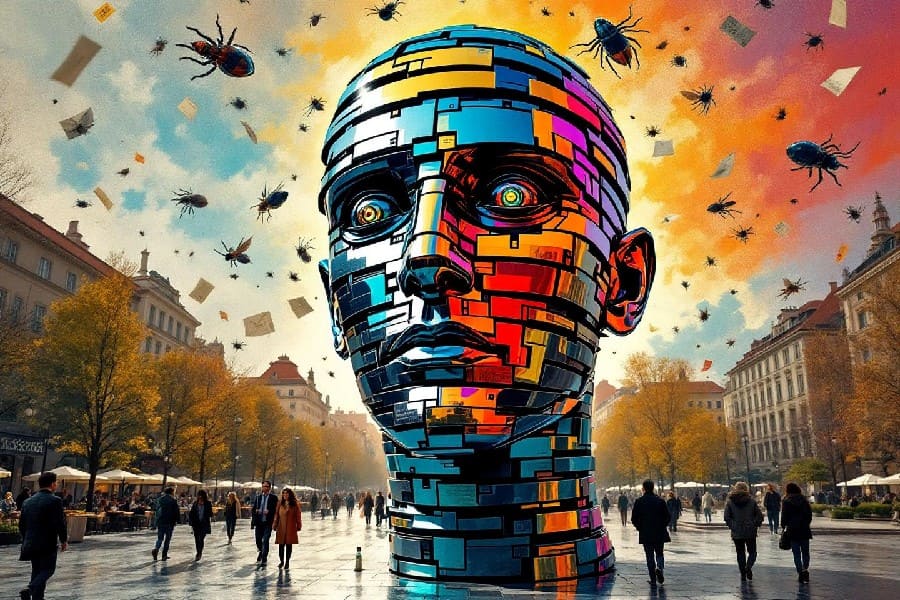
A Stop on Kafka's Trail • David Černý
You are standing right before a face that never stops changing
Why does the giant head of Franz Kafka fragment into dozens of moving layers and piece itself back together? Discover the story behind one of the most remarkable modern artworks in Prague – and then follow in Kafka's footsteps right from here.
Before you continue…
Put your phone away for a moment and look up.
Notice:
How many individual layers make up Kafka's face,
How his expression changes as the different parts rotate,
Whether you see only Kafka in the reflective surface, or also yourself.
Because this sculpture doesn't look the same for even two minutes in a row.
Who created the moving head?
The artwork was created by Czech artist David Černý, known for his monumental and technically demanding installations.
The moving Head of Franz Kafka was unveiled in 2014 in front of the Quadrio shopping centre. It is not just a sculpture, but a kinetic work of art that connects artistic vision, mechanics, and modern technology.
How can such a giant head rotate?
Kafka's face consists of 42 individually moving layers made of polished stainless steel.
Each layer can rotate independently. At one moment, the face is clearly recognizable; a few seconds later, it dissolves into abstract shapes and then reassembles itself.
The entire installation stands 10.6 metres tall and weighs approximately 39 tonnes. Hidden inside are servomotors, sensors, and nearly a kilometre of cables.
Did you know that…
The stainless steel cladding weighs approximately 24 tonnes,
Each layer is driven by an independent servomotor,
Thousands of technical drawings were created during development,
Construction and assembly took approximately six months,
Sensors monitor the correct alignment of individual tiers.
Why Franz Kafka?
Kafka often wrote about people losing certainty, control, or their original identity.
This head transforms in much the same way. At times, the face is complete and easily recognizable, only to break apart into dozens of pieces a moment later. You can see in it the fluidity of human identity, the clash between how we perceive ourselves and how the world sees us.
There is no single correct interpretation. It all depends on what you discover in the artwork yourself.
The reflective layers do not merely mirror the surrounding buildings and sky. If you stand closer, you will see yourself reflected in them as well. For a moment, you become part of Kafka's face – an image composed of dozens of perspectives and reflections.
Perhaps that is the most Kafkaesque thing about this sculpture.
Discover more of Kafka's trail
Embark on the interactive city game The Lost Letter of Franz Kafka. Starting right from this moving head, it will lead you through historic Prague. You'll solve ciphers, look for subtle details, and gradually piece together a letter that, according to legend, was meant to stay hidden forever.
Uncover the lost letter →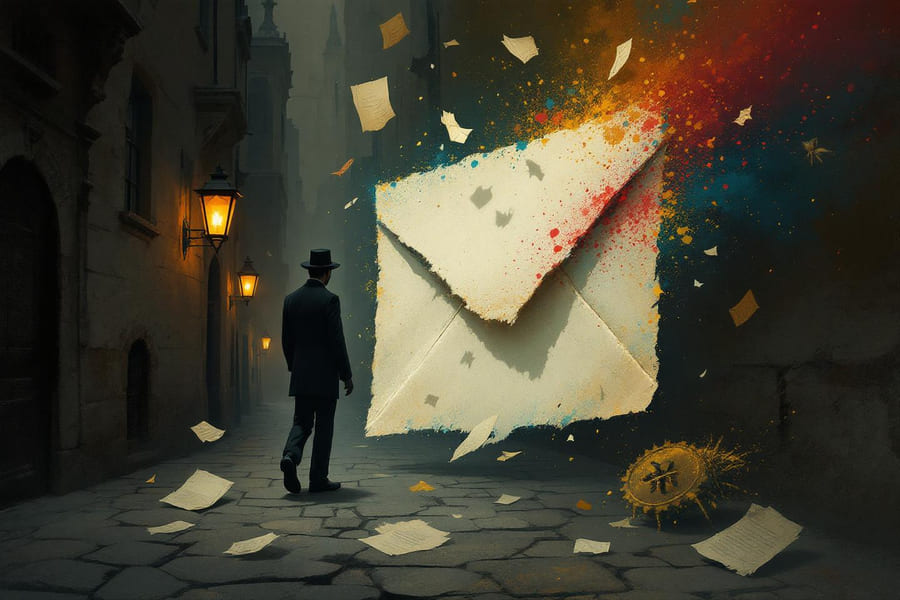
The Lost Letter of Franz Kafka
Legend has it that shortly before his death, Franz Kafka wrote a letter into which he poured his innermost thoughts.
In the end, he tore it into many pieces and scattered them across Prague so that no one could ever read it.
It is up to you to find the individual clues.
Head through the historical streets of Prague, solve ciphers, reveal hidden symbols, and gradually piece together a story connecting real places with literary imagination.
This is no ordinary city tour.
It is an interactive city game in which you become part of the story yourself.
What awaits you?
✔ Approximately 2 hours of fun
✔ Route through the historical centre of Prague
✔ Original riddles and ciphers
✔ Real places connected with Franz Kafka
✔ Ideal for couples, families, and friends
✔ All you need is a mobile phone
Your Kafkaesque adventure starts right here
Embark on the interactive city game The Lost Letter of Franz Kafka. Starting right from this moving head, it will lead you through historic Prague. You'll solve ciphers, look for subtle details, and gradually piece together a letter that, according to legend, was meant to stay hidden forever.
Uncover the lost letter →