In Franz Kafka's footsteps
Kafka's Prague: where he lived, wrote and where to find him today
Kafka spent almost his whole life in Prague, and the city is full of his traces. Here's where to find them – from the house where he was born to the sculptures that remember him today.
Key points
Kafka's Prague at a glance
Born in the Old Town
Franz Kafka was born on 3 July 1883 in the House at the Tower, next to St. Nicholas Church.
The Metamorphosis was written here
He wrote in the House at the Ship on the edge of Josefov and in his sister's tiny house on Golden Lane.
Two sculptures, two takes
Jaroslav Róna's bronze Kafka and David Černý's rotating head.
Play Kafka's Prague
Our outdoor story game The Lost Letter of Franz Kafka takes you along his trail.
Where Kafka lived and wrote
“This little mother has claws,” Kafka wrote about Prague. It never let him go – most of his places lie within a few hundred metres of Old Town Square.
The House at the Tower – where he was born
Kafka was born on 3 July 1883 in the House at the Tower (U Věže), on the corner of today's Maiselova and U Radnice streets, right by St. Nicholas Church. The original house was demolished during the clearance of the old Jewish Quarter; only its Baroque portal survives, set into today's building. A bust of Kafka from 1966 marks the spot, and since 2000 the square in front has been called Franz Kafka Square.
The House at the Minute – a childhood on Old Town Square
The family lived in this striking sgraffito-covered house next to the Old Town Hall from 1889 to 1896. All three of Kafka's sisters – Elli, Valli and Ottla – were born here.
The House of the Three Kings and the Kinsky Palace
Kafka's father Hermann ran his shop at Celetná 3 from 1887, and the whole family later moved in. Franz spent his school and university years here. He attended the German grammar school in the Goltz-Kinsky Palace on Old Town Square, where his father also moved the shop in 1912. Today the palace belongs to the National Gallery.
The House at the Ship – where The Metamorphosis was born
The house where Kafka wrote The Metamorphosis stood where the InterContinental hotel is today, at Pařížská 36. The building is long gone, but this is where Gregor Samsa's story began, on the edge of Josefov.
Golden Lane 22 – a writing room at the castle
In 1916 Kafka's favourite sister Ottla rented house No. 22 and let her brother use it. From November 1916 to April 1917 he came here to write. Golden Lane is now part of the Prague Castle visitor circuit.
Where Kafka worked
His first job, in 1907, was at the Prague branch of the insurance company Assicurazioni Generali, on the corner of Wenceslas Square and Vodičkova Street. But he spent most of his career, from 1908 to 1922, at the Workers' Accident Insurance Institute at Na Poříčí 7 – today the Hotel Century Old Town.
The New Jewish Cemetery – his final resting place
Kafka died in 1924 in a sanatorium near Vienna, aged just 40. He is buried in the family grave at the New Jewish Cemetery in Prague.
Where to find Kafka today
The rotating Head of Franz Kafka
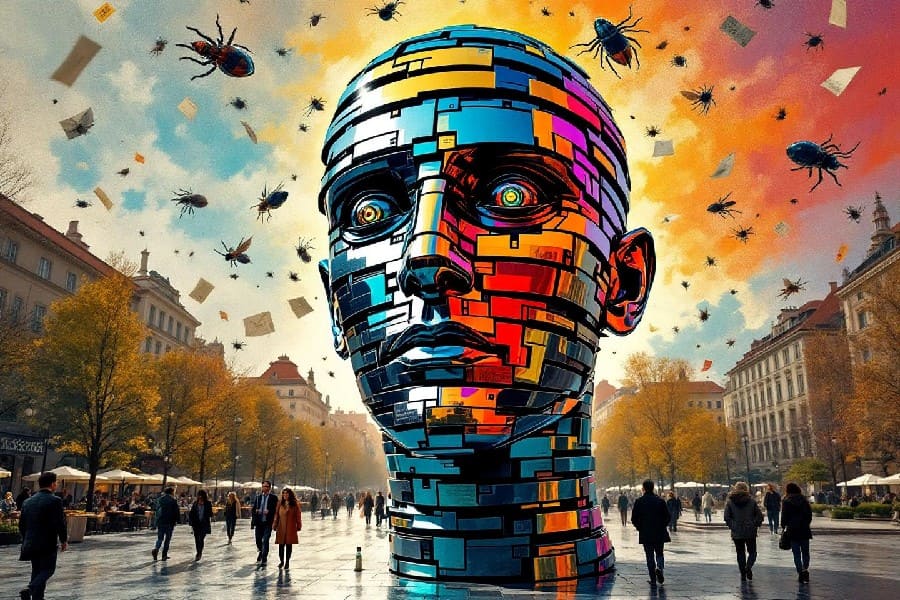
David Černý's kinetic sculpture outside the Quadrio shopping centre, unveiled in 2014. 42 stainless-steel layers keep breaking apart and reassembling into Kafka's face. This is where our outdoor story game begins. The full story of the sculpture.
The statue by Jaroslav Róna
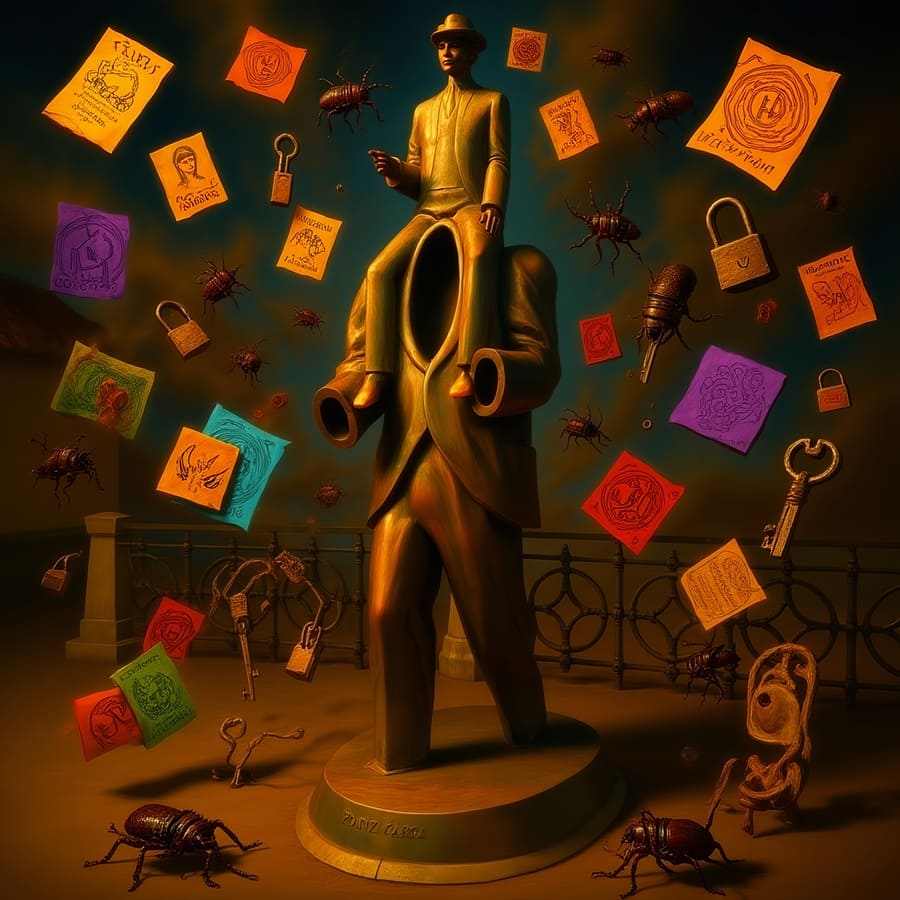
A bronze Kafka riding on the shoulders of a headless figure, on Dušní Street by the Spanish Synagogue, unveiled in 2003. It was inspired by Kafka's story Description of a Struggle. What the statue means.
The Franz Kafka Museum
An exhibition in the Cihelna complex in the Lesser Town about Kafka's life and how he transformed Prague in his writing. Outside stands another David Černý piece – two men peeing into a pool.
Kafka's Prague in one walk
You can walk the main places in the centre in about half a day. Suggested order:
- Franz Kafka Square – the House at the Tower
- The House at the Minute and Old Town Square
- The Goltz-Kinsky Palace
- The House of the Three Kings on Celetná Street
- The Franz Kafka statue on Dušní Street
- Pařížská 36 – where The Metamorphosis was written
- Across Mánes Bridge to the Franz Kafka Museum
- Golden Lane 22 at Prague Castle
The rotating head at Quadrio and the former insurance institute on Na Poříčí are on the other side of the centre – worth a separate stop. And if you'd rather follow a story than a list of addresses, try the outdoor story game The Lost Letter of Franz Kafka. For more ideas on seeing Prague differently, see our Unconventional Prague Guide.
Kafka's Prague as an outdoor story game
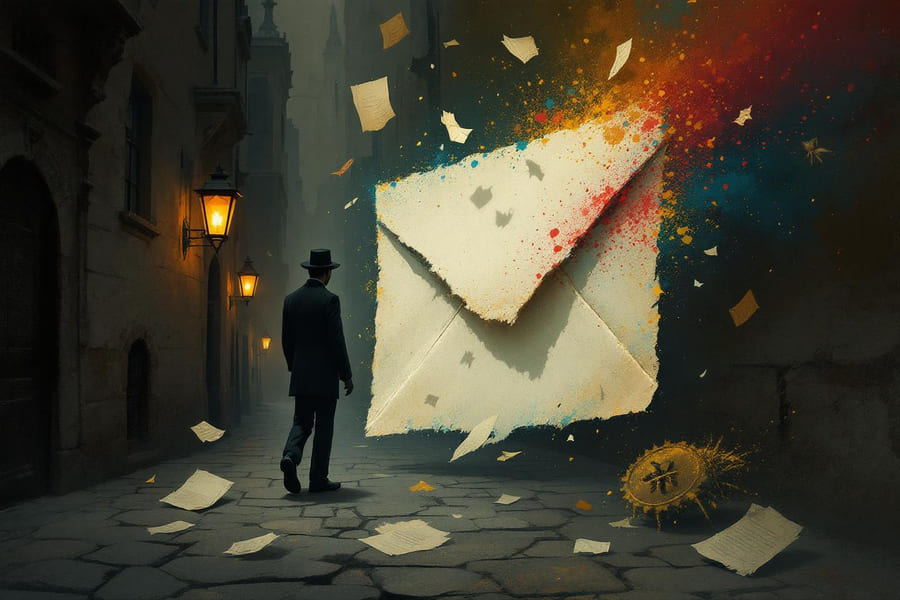
Legend has it that before he died, Kafka tore up a letter holding his most secret thoughts and scattered the pieces across Prague. Find the clues, crack the ciphers and piece the story together – on your phone, anytime, no guide.
The Lost Letter of Franz Kafka
An old legend, a bit of literary magic, and a good dose of adventure – before his death, Kafka wrote a letter in which he revealed his innermost thoughts, and then tore it into pieces so that no one could read it. Its remains, however, are wandering through historical Prague, and your task is to follow in their footsteps.
FAQ
Where was Franz Kafka born?
In the House at the Tower next to St. Nicholas Church, on today's Franz Kafka Square. Only the Baroque portal of the original house survives.
Where is Franz Kafka buried?
In the family grave at the New Jewish Cemetery in Prague.
Did Kafka live on Golden Lane?
Not quite. House No. 22 was rented by his sister Ottla, and Kafka used it as a writing room in 1916–1917.
Where in Prague was The Metamorphosis written?
In the House at the Ship, at today's Pařížská 36. The house no longer stands; the InterContinental hotel is there now.
Can I explore Kafka's Prague without a guide?
Yes. Walk the central places on your own, or play The Lost Letter of Franz Kafka – an outdoor story game on your phone that you can start anytime.
Follow in Kafka's footsteps
The Lost Letter of Franz Kafka: about 2 hours, 2–6 players, 19 EUR per team. Play anytime in your phone's browser – no app, no guide.
Uncover the lost letter